
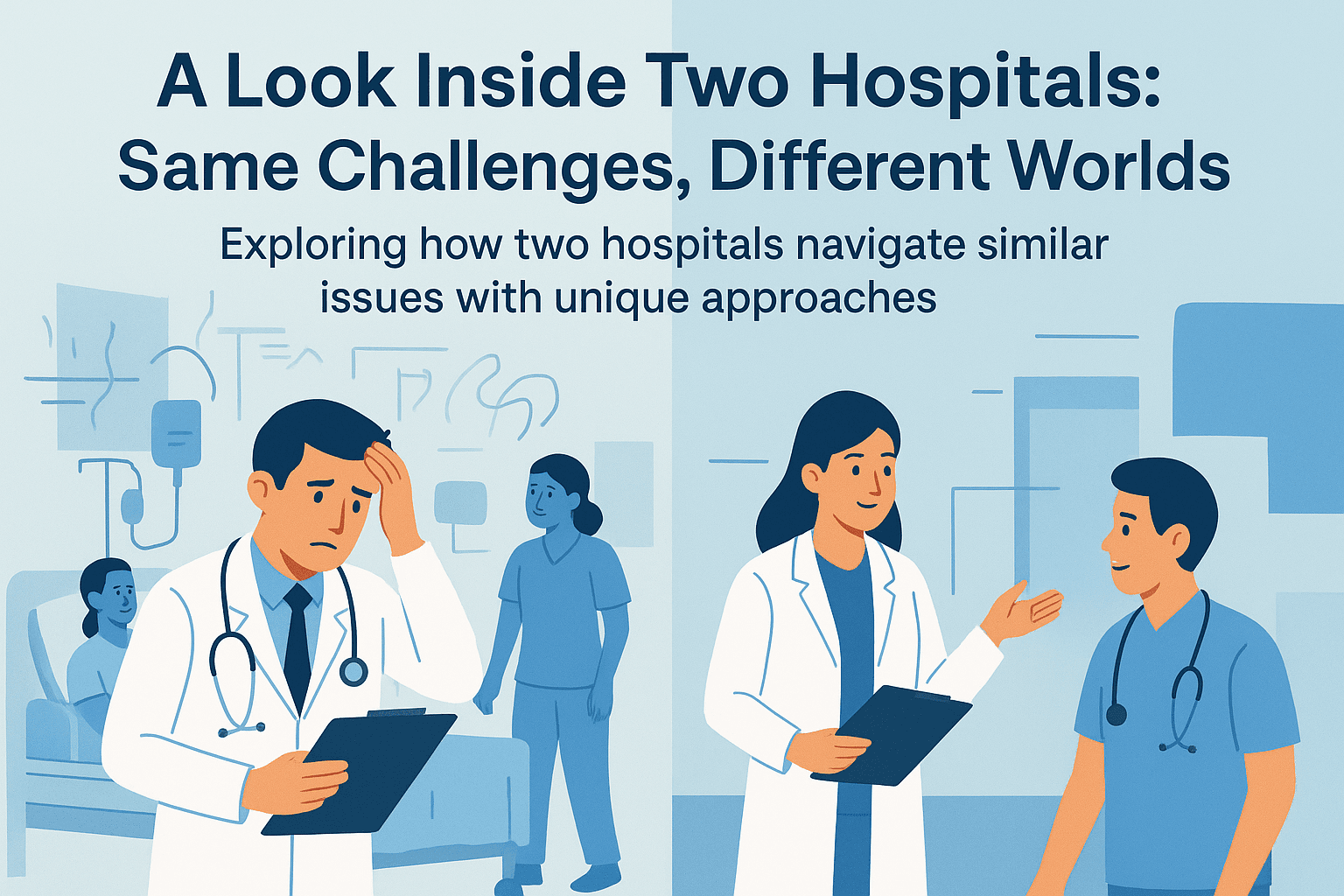
Healthcare is universal — the setting may differ, but the pain points rarely do. From Delhi to Dubai, London to Lucknow, every hospital battles the same underlying challenges: long queues, fragmented communication, administrative chaos, and strained patient-doctor relationships. Yet, the ways hospitals navigate these hurdles often reflect their environment, culture, and technological maturity.
Let’s step inside two very different hospitals — one in a bustling Indian metro, and another in a developed global healthcare hub — to understand how the challenges are identical, but the solutions are worlds apart.
1. The Common Ground: Chaos Beneath the Care
Both hospitals share one truth — patients expect faster, more personalized care, while doctors juggle impossible workloads.
Patient waiting times stretch longer than expected.
Administrative inefficiency drains valuable clinical time.
Data silos make coordination a daily struggle.
Doctor burnout continues to rise amid increasing patient loads.
No matter the geography, these challenges form the invisible pressure points of modern healthcare systems.
2. The Indian Hospital: Adapting Amidst Volume and Velocity
In India’s urban hospitals, volume defines the ecosystem. Hundreds of patients walk through OPDs daily, each needing attention, empathy, and clarity.
The administrative staff races to manage registrations, records, and appointments — often across disconnected systems.
Despite these hurdles, Indian hospitals show remarkable adaptability and resilience. Cost constraints drive innovation:
AI-powered scheduling tools are improving patient flow.
Digital OPD management systems like ROVA are streamlining coordination.
Teleconsultation and WhatsApp-based follow-ups reduce patient drop-offs.
This flexible, frugal innovation mindset allows Indian hospitals to evolve even within resource constraints.
3. The Global Hospital: Structure with a Human Touch
Across the world, a hospital in, say, the UK or Singapore, faces the same complaints — delays, cancellations, and staff shortages. The difference lies in how systematically technology is integrated into operations.
Unified EMRs connect every department seamlessly.
AI-driven triage systems prioritize cases intelligently.
Patient engagement portals empower patients to manage their health journeys.
While resources and regulations support these advancements, the human touch remains at the core. Nurses and coordinators still bridge the gap between systems and emotions — between efficiency and empathy.
4. The Cultural Lens: Innovation vs. Implementation
Technology alone doesn’t solve healthcare’s deepest issues — culture does.
In India, innovation is fast but fragmented; in the West, implementation is structured but slower.
Both systems could learn from each other:
Indian hospitals’ agility and creativity can inspire developed systems to adapt faster.
Western hospitals’ discipline and process rigor can help Indian hospitals scale sustainably.
Together, they point toward a hybrid model of care: tech-powered, patient-centered, and globally informed.
5. The Common Destination: Patient Experience as the True North
Whether it’s a super-specialty center in Mumbai or a teaching hospital in London, the ultimate goal is the same — a seamless patient experience.
AI, automation, and digital transformation are not ends in themselves — they are tools to restore the human connection in healthcare.
As ROVA and similar AI systems bridge gaps across borders, healthcare is slowly shifting from reactive treatment to proactive, coordinated care.
Conclusion:
Different worlds, same heartbeat.
Every hospital, regardless of its size or location, stands on the same frontline of patient care. The more they learn from each other — combining local ingenuity with global innovation — the closer we move toward a truly borderless, human-centered healthcare ecosystem.
Published on 5 months ago
Recommended Articles
More articles from Artificial Intelligence
Reducing Operational Bottlenecks in Hospitals: A Practical Guide
Operational bottlenecks in hospitals—such as long wait times, missed appointments, overloaded call centers, and lack of follow-ups—directly impact patient experience and staff efficiency. These challenges often stem from manual processes and the absence of centralized systems. By adopting smarter solutions like automation, AI-driven communication, streamlined scheduling, and data analytics, hospitals can significantly improve workflow efficiency and patient engagement. Ultimately, reducing bottlenecks is not just about optimizing operations—it’s about delivering faster, more reliable, and patient-centric care while enabling sustainable growth.

Vibe Coding - When the IDE Thinks With You
Vibe Coding is redefining how developers build software by enabling a more natural, AI-augmented workflow where ideas are translated into code in real time. Instead of getting stuck in repetitive tasks or context-switching, engineers stay focused on problem-solving while intelligent tools handle execution. At RxOne, this shift has accelerated development cycles, improved collaboration, and aligned perfectly with their Agentic AI vision—where human intent is amplified by intelligent systems to build faster, smarter healthcare solutions.

Sarathi (RxOne Voice AI for Students) - an Essential Companion in Modern Education
An Agentic AI Student Helpline like Sarathi transforms fragmented, reactive campus support into a unified, intelligent, and always-available companion. From admissions and academics to mental health, finances, placements, and grievance handling, Sarathi provides real-time, personalized guidance while proactively engaging students. This not only reduces anxiety and improves student experience but also enhances institutional efficiency and decision-making through data insights. As education evolves, such AI-driven systems are becoming essential—shifting from basic support tools to continuous, predictive companions in a student’s journey.

Meet Giva — The Voice That Shows Up When Mothers Need It Most
Motherhood is beautiful — but the journey into it can feel overwhelming, especially for first-time mothers navigating fragmented healthcare systems. At RXOne, we built Giva, a voice-first care companion powered by Rova, to simplify the pregnancy journey through proactive, contextual, and multilingual support. Giva isn’t just a chatbot — it’s an orchestration engine that coordinates appointments, answers pregnancy-related queries, connects mothers to trusted providers, and ensures continuity of care through natural voice interaction. By leveraging RXOne’s local linguistic intelligence in Rova, Giva understands mothers in the language they actually speak — improving accessibility, trust, and engagement. Early deployments show reduced care friction, better adherence to checkups, improved patient confidence, and scalable support without increasing human workload. From tools to true care companions — this is the future of maternal healthcare.